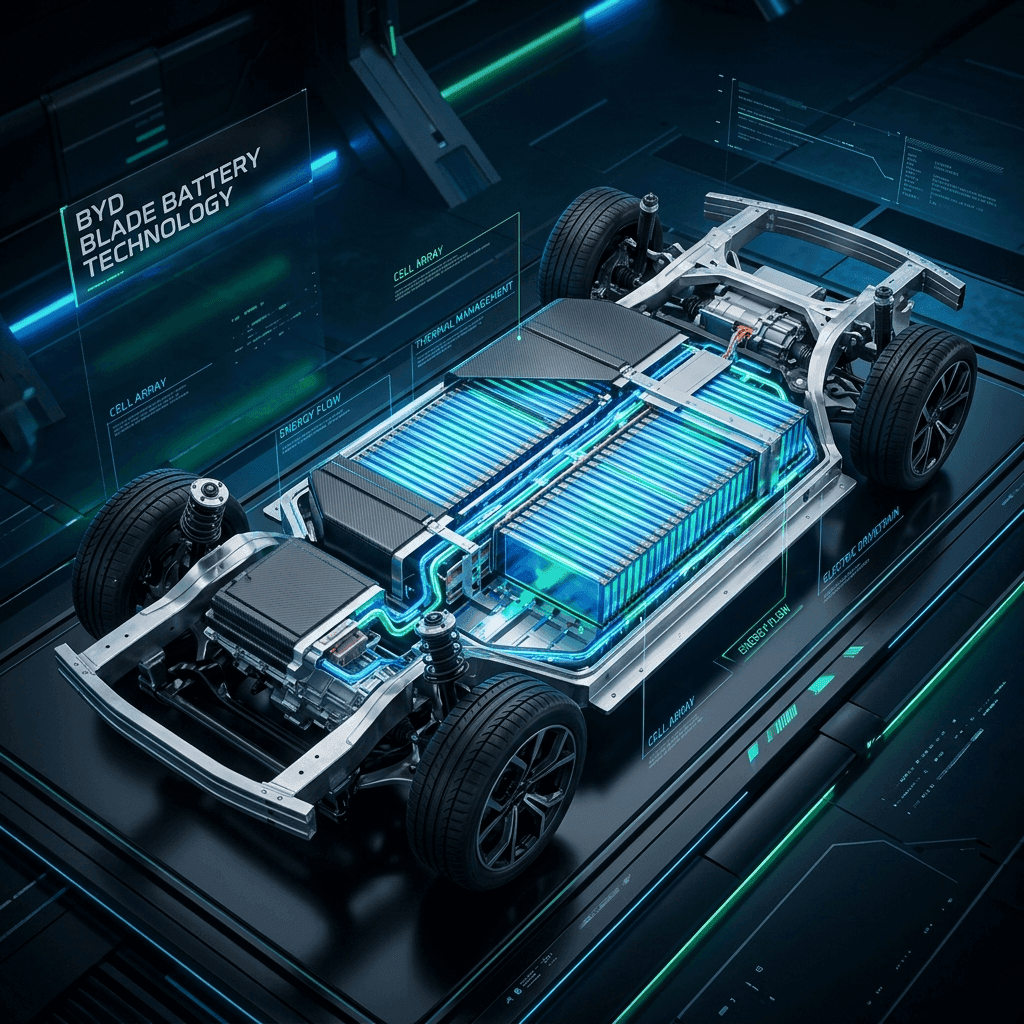
The BYD Blade Battery in Plain Words
When people talk about BYD's reliability, they mostly mean the Blade battery. That's not marketing — there's specific chemistry and construction behind it, especially important in Uzbekistan's hot climate. Let's explain without the jargon.
What the Blade is
The Blade is a lithium-iron-phosphate (LFP) battery shaped as long thin "blades" (hence the name), packed tightly to form part of the body's structure. Two key differences from ordinary lithium (NMC) batteries:
- LFP chemistry — more stable and safe. It doesn't tend toward thermal runaway (fire), even when damaged. BYD has publicly nail-punctured a Blade without ignition.
- Cell-to-body construction — the battery is rigid and compact, improving handling and cabin space.
Why it matters specifically for Uzbekistan
- Heat. LFP batteries tolerate high temperatures better than ordinary NMC. Tashkent summers have less effect on lifespan and safety.
- Long lifespan. LFP withstands more charge-discharge cycles — meaning it lives longer and holds resale value better.
- Safety. For a family car, fire resistance is a serious argument.
The downside (honestly)
LFP is slightly less energy-dense than NMC, so at equal weight range can be a little lower. But for most scenarios in Uzbekistan, safety, lifespan and heat tolerance outweigh that nuance.
Verdict
If you're choosing an EV for a hot climate and want maximum reliability and longevity, the Blade battery is a weighty plus. BYD models with the Blade are in the catalog; how the battery affects resale is in the resale value guide.